

With the MAOF Carcass Disposal System, you’ll avoid the hassle of composting and the risk of third parties coming to your site. Instead, you’ll save time and money by taking mortality management into your own hands.
All you need to do is load the machine and start the cycle.
The carcasses will be heated and mixed to break down bones and feathers, thermally treating the material through controlled heating and continuous mixing. The contents are dried to your desired level of dehydration, then transferred to the storage bin.
And what’s left? A dry, stabilized organic material (meat meal) suitable for on-farm management, including composting or integration into existing waste handling practices.
THE EJECTION SCREW
A maintenance free screw system, will propel the “MEAT POWDER” out of the drying chamber, and eject it into a bag or container. The operator can control the time of the screw operation and stop the process to move and replace the storage container/bag. Typically, a 15 minute screw operation time is sufficient to empty the drying chamber. It is critical that the drying chamber is completely empty at the end of a cycle.
THE BYPRODUCTS- “MEAT POWDER”
Management options for the material produced by the system:
The process results in a dry, stabilized organic material (meat meal) with reduced moisture and odor. It is typically managed on-farm within existing waste handling or composting practices, in accordance with local regulations.
In some cases, the material may be incorporated into fertilizer streams or further processed, subject to applicable regulatory approvals. Any such uses should be evaluated locally to ensure compliance.
TESTING & APPROVALS
The approval process included in-depth, long-term analysis of the effectiveness of the thermal dehydration process, aerial emissions and environmental impact of thermal dehydration of poultry mortalities.
These efforts have determined that there are no visible emissions from the thermal dehydration unit, other than water vapor. Volatile organic compounds (VOC) emissions are only minimally elevated from the exhaust stack compared to background VOC levels during operation.
The process produces a dry, stabilized organic material (meat meal) with reduced moisture and odor. It is typically managed on-farm within existing waste handling or composting practices, in accordance with local regulations.
In certain cases, the material may be incorporated into fertilizer streams or further processed, subject to applicable regulatory approvals.
Compositional analysis has shown a typical moisture content of approximately 20%, with indicative nutrient levels of around 10% nitrogen (N), 0.5% phosphorus (P), and 0.6% potassium (K). These values may vary depending on input material and operating conditions.
The system is designed for on-farm mortality management. The material produced is not intended to be a regulated end product and should be handled in accordance with local regulations.
PROCESS CONTROL
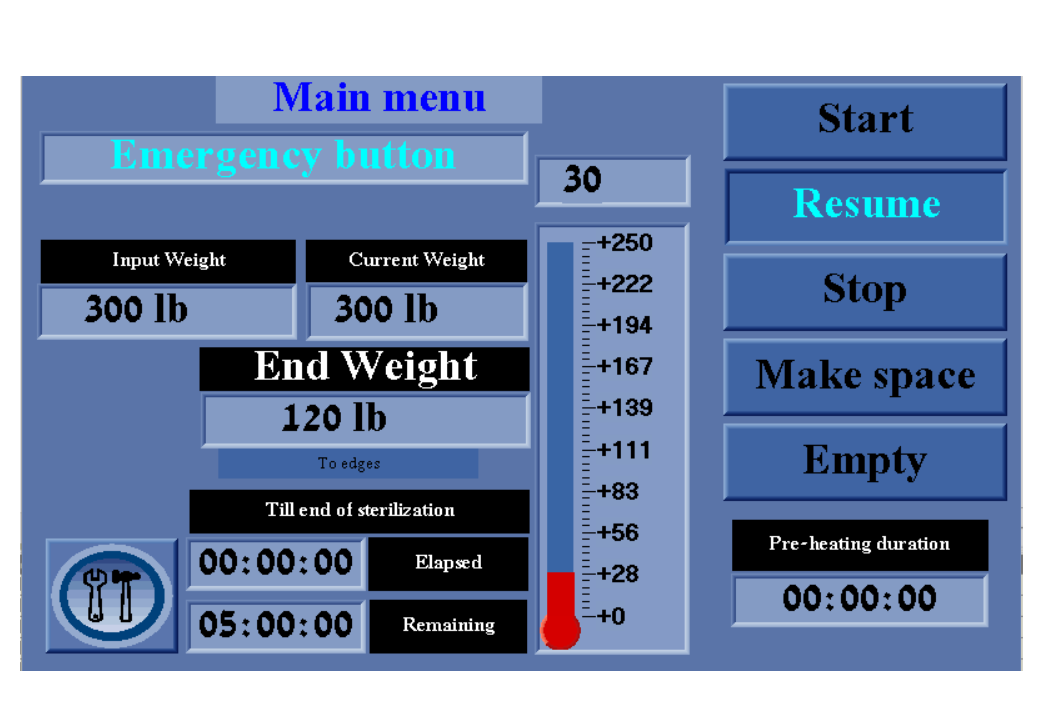
The system is computerized and controlled. Registered and controlled data (temperature and weight). Different operating programs depending on the carcasses weight. Features include: power saving in night operation. remote activation (optional) , fault reporting.
SAFETY
Numerous safety features have been included in the design to protect all workers. The design engineers, who are also farmers, are aware that youth are often operating farm machinery. One critical safety feature is the stop motor safety switch, which ensures that there are no moving components when the carcass loading door is opened.
The loading door is always at the optimal height for loading- irrespective of the size of the model.

PROCESS AUTOMATION
Manual labor is only required to load the carcasses. The system is fully automated. The system cannot be operated if the loading door is not shut securely. For the purpose of our promotional videos, the engineers bypassed the safety lock on the loading door. The bypass cannot be implemented in the machines supplied to clients.


MAOF Green Solutions Ltd.
Jordan Valley
Israel
Tel: +972 54-4252103 WhatsApp番号
info at maofgreensolutions.com
© All Rights Reserved 2022 MAOF Green Solutions Ltd.